
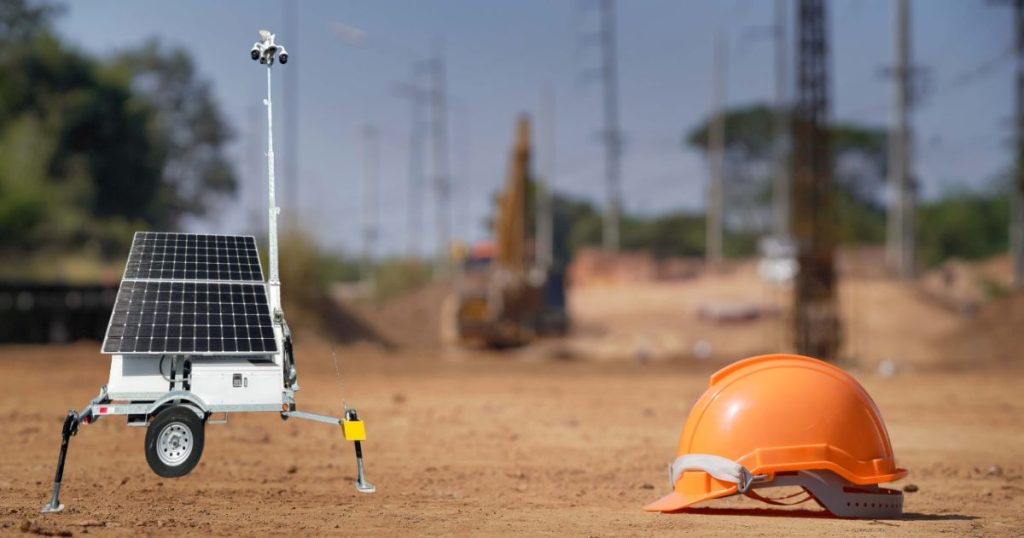
If you manage a construction site in California, you know the risks: stolen equipment, trespassing, vandalism, and costly delays. In response, many construction firms have turned to mobile security camera trailers, hoping to deter crime with a visible presence.
And while these systems do serve a purpose, they often provide a false sense of security.
The hard truth? Cameras can record a crime, but they can’t stop it.
Let’s break down the limitations of camera trailers and explain why a human response team remains the most effective security solution for high-risk construction environments.
The Rise of Camera Trailers on Construction Sites
Camera trailers are mobile surveillance units typically equipped with motion-detecting cameras, floodlights, speakers, and remote monitoring capabilities. They’re popular because they’re:
- Easy to deploy
- Non-intrusive to workers
- Viewed as a cost-effective alternative to on-site guards
They’re also a step up from doing nothing at all, but as crime becomes more organized and fast-paced, relying solely on technology can backfire.
1. Delayed Response Times Can Be Costly
One of the biggest construction site security camera trailer limitations is the delay between detection and response.
Even when motion is detected and a monitoring team is alerted:
- It may take several minutes to confirm a threat
- Law enforcement must then be contacted
- Officers may take 15–45 minutes or more to arrive
By then, the damage may already be done. According to the National Equipment Register, the average value of stolen construction equipment per incident exceeds $29,000, and only a small percentage is ever recovered.
A camera may help with post-incident investigation, but it can’t intervene in the moment.
2. No Deterrence for Determined Criminals
While camera trailers do offer some visual deterrence, seasoned criminals know the difference between a surveillance trailer and a guard who can take action.
And in many cases, camera trailers:
- Can be avoided by taking alternate routes
- Are tampered with or vandalized
- Are ignored altogether during after-hours break-ins
If your site is in a high-crime area or contains high-value assets, you need more than just a recording device.
3. Blind Spots Still Exist
No matter how advanced your camera system is, you can’t eliminate every blind spot, especially on an evolving construction site where:
- Equipment is constantly moving
- Structures are being built
- Weather and lighting affect visibility
Camera trailers are often fixed in one spot, which limits their field of view. Without an active human presence walking the perimeter or adjusting to dynamic risk areas, key vulnerabilities remain exposed.
4. No Intervention During Escalating Incidents
Security isn’t just about catching thieves. It’s also about:
- De-escalating confrontations
- Managing loiterers or trespassers
- Reporting safety hazards that could result in lawsuits
None of these can be addressed by a camera alone.
A trained security officer can make contact, issue warnings, document behavior, and engage with law enforcement far more effectively than a trailer and speaker.
5. Insurance and Liability Gaps
Many insurance providers look for active deterrents, not passive ones.
If your policy requires “reasonable protective measures,” a camera trailer may not be enough. In the event of a claim:
- You may be asked to show proof of attempted prevention
Delayed response or insufficient monitoring can raise red flags - Unattended cameras may not satisfy duty-of-care requirements
Talk to your insurance provider about what qualifies as sufficient protection. Better yet, conduct a security assessment to ensure you’re covered.
Why Trained Security Guards Make the Difference
A camera can watch. A guard can act.
When paired with mobile patrols or stationed on-site, professional security officers:
- Conduct perimeter walks and equipment checks
- Engage with suspicious individuals in real time
Assist with safety protocols and after-hours access - Provide detailed incident reporting for legal protection
- Coordinate with emergency services for faster outcomes
At Delta Protective Services, our guards are not only BSIS-certified but also trained in de-escalation, reporting, and jobsite etiquette. We understand the balance between protection and productivity.
When to Upgrade from Cameras to Guards
You should consider augmenting or replacing camera trailers with on-site security if:
- Your site stores high-value tools or materials
- You’ve experienced past incidents of theft or trespassing
- You operate overnight or on weekends
- Local police response is slow or unreliable
- Your insurance provider recommends physical deterrents
Mobile patrols are also a powerful middle-ground solution providing visibility, flexibility, and cost savings across multiple job sites.
External Resources on Construction Site Security
For further industry context:
- National Equipment Register (NER): Theft Prevention Tips
- OSHA: Recommended Practices for Safety and Health Programs
These organizations provide valuable insights into best practices and legal standards that impact how you protect your site and your workers.
Final Thought: Surveillance Alone Is Not Security
In today’s construction environment, risk is too high to rely on tech alone. Camera trailers may capture the crime, but they can’t confront it, contain it, or prevent it.
Real security means real response.
Ready for a Smarter Security Plan?
Delta Protective Services helps construction leaders across California combine technology with trained personnel for stronger, smarter protection.
Call us at (209) 547-2980
Request your custom security proposal today