
Have you ever written an email, reread it three times, added another paragraph to make sure you didn’t sound rude, and then apologized for something that didn’t even require an apology?
Oh, honey. We need to talk.
Because somewhere along the way, too many successful women learned that communicating professionally meant making everyone else comfortable.
We soften our requests. We justify our decisions. We explain our boundaries. We apologize for asking questions, taking up time, and sometimes simply doing our jobs.
And while our intentions may be good, the results aren’t always working in our favor.
The more you explain, the less confident your message can sound.
Not because explanations are bad. Not because kindness is weakness. But because when you bury your message beneath unnecessary details, apologies, and justifications, you make it harder for people to understand what you need and trust your direction.
After more than 30 years of building businesses and leading in male-dominated industries, I’ve learned that effective communication isn’t about saying everything.
It’s about saying what matters.
And that shift can change how people experience your leadership.
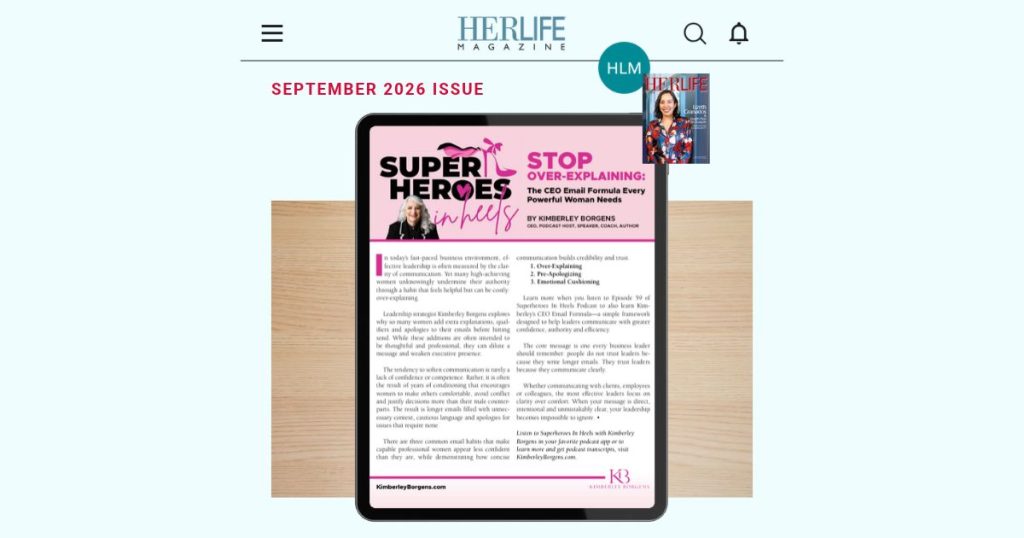
My HERLIFE Magazine Article: Stop Over-Explaining
I recently explored this topic in an article I wrote for HERLIFE Magazine, titled “Stop Over-Explaining: The CEO Email Formula Every Powerful Woman Needs.”
In that feature, I discussed three communication habits that can quietly undermine a woman’s authority:
- Over-explaining
- Pre-apologizing
- Emotional cushioning
These habits often come from a desire to be thoughtful, professional, and considerate. But when we use them automatically, they can make even highly experienced women sound uncertain about their own decisions.
The message I shared in HERLIFE is simple: people don’t trust leaders because they write longer emails. They trust leaders because they communicate clearly.
You can explore the magazine’s previous editions through the HERLIFE Magazine Central Valley archives.
That original article focused on recognizing the habits that weaken our communication. Here, I want to take the conversation further.
Let’s talk about how to replace those habits with practical communication strategies that help you build credibility, protect your boundaries, and lead with greater authority.
Why Do Successful Women Over-Explain?
Over-explaining isn’t always a sign of insecurity.
Sometimes it’s a habit developed after years of navigating expectations, responsibilities, workplace dynamics, and other people’s reactions.
Perhaps you’ve experienced situations where being direct was interpreted as aggressive.
Perhaps you’ve learned that saying no creates conflict, so you provide a lengthy explanation to soften the disappointment.
Or perhaps you’ve spent years being the person everyone depends on, and you feel responsible for making sure nobody is upset, confused, or uncomfortable.
For women working in male-dominated industries, these concerns can feel especially familiar.
You may already be working harder to establish credibility. You may be more conscious of how your tone is received. And you may feel pressure to demonstrate that you’re competent without appearing overly assertive.
So you add another sentence.
Then another explanation.
Then a little apology to make it sound nicer.
Before you know it, your straightforward decision has become a five-paragraph essay.
Here’s what I want you to understand.
You can be respectful without being apologetic. You can be kind without being unclear. And you can be confident without being confrontational.
The goal isn’t to change your personality.
It’s to strengthen your communication.
The Three Communication Habits That Quietly Weaken Your Authority
1. Over-Explaining: When Too Much Information Hides Your Message
Let’s say a client asks you to complete a project earlier than originally agreed.
Your instinct might be to explain everything happening behind the scenes.
You describe your current workload, your other commitments, the team’s schedule, the reasons the original deadline was selected, and why changing it would be difficult.
But the client doesn’t necessarily need your entire operational history.
They need to know whether the new deadline is possible and what options are available.
Instead of writing a lengthy explanation, try:
“The original delivery date is Friday. We can accommodate Wednesday with an adjusted scope, or keep the full scope for Friday. Let me know which option works best.”
Clear. Professional. Solution-focused.
You communicated the boundary and provided a path forward.
That’s leadership.
2. Pre-Apologizing: Stop Saying Sorry Before You’ve Done Anything Wrong
How many times have you started an email with:
“Sorry to bother you…”
“Sorry for the question…”
“Sorry to follow up again…”
Sometimes an apology is absolutely appropriate. If you’ve made a mistake, missed a commitment, or caused inconvenience, take responsibility.
That’s part of being a good leader.
But asking a legitimate question, requesting information, or following up on a business commitment doesn’t automatically require an apology.
Try replacing:
“Sorry to bother you, but I was wondering if you’ve had a chance to review my proposal.”
With:
“I’m following up on the proposal I sent Monday. Do you have any questions I can answer before we move forward?”
One sounds like you’re asking permission to participate.
The other sounds like you’re managing a professional conversation.
You haven’t lost your warmth.
You’ve gained clarity.
3. Emotional Cushioning: You Don’t Have to Manage Everyone’s Reaction
Emotional cushioning happens when you add unnecessary language to protect someone else from a perfectly reasonable message.
For example:
“I completely understand if this doesn’t work, and I really hate to ask, but I was hoping we could possibly move our meeting…”
What are you actually asking?
To reschedule a meeting.
That’s it.
Try:
“I need to reschedule our meeting. I’m available Thursday at 2 or Friday at 10. Which works better for you?”
You’re allowed to make a request without presenting a case for why you deserve to make it.
And you’re allowed to communicate expectations without apologizing for having them.
The CEO Email Formula: How to Communicate With Confidence
One of the simplest ways to strengthen your business communication is to create a structure for your messages.
I recommend thinking about your emails in four parts.
Step 1: State Your Purpose
Start with the reason you’re writing.
Don’t make the reader search through several paragraphs to figure out what you need.
Examples:
“I’m following up on our proposal.”
“I’d like to confirm the project timeline.”
“I’m requesting approval to move forward.”
“I want to address a concern about the current process.”
The point should be clear almost immediately.
