
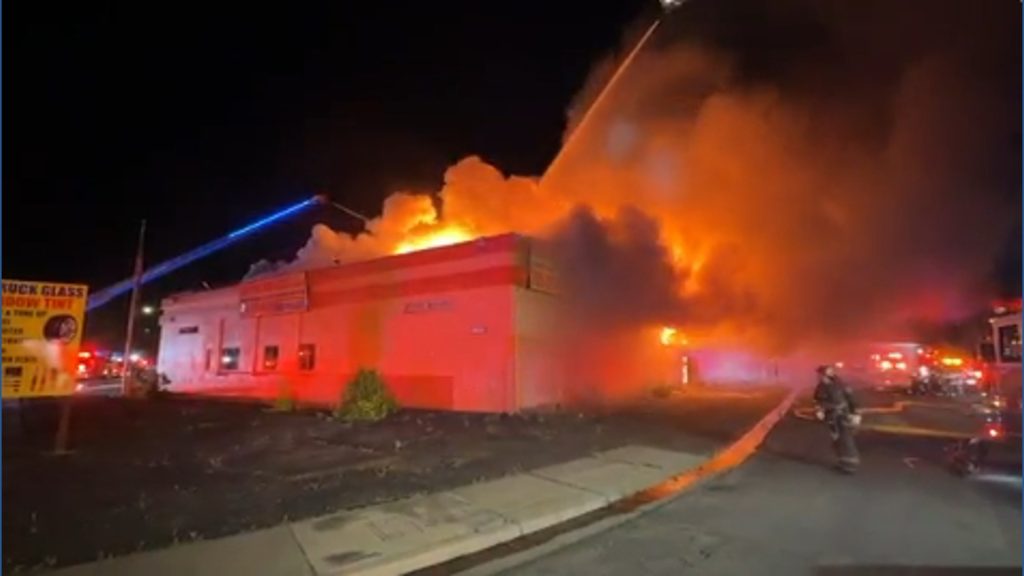
A recent overnight warehouse fire in Stockton is a sharp reminder that after-hours business risk is not limited to theft. According to ABC10, a late Friday structure fire in Stockton caused an estimated $1.3 million in damage and left about 1,500 customers without power. KCRA also reported that firefighters described the blaze as a challenging commercial fire, and there were no injuries reported.
For warehouse owners, property managers, and neighboring businesses, that kind of incident raises a bigger question:
What happens to your operation, your site, and your surrounding properties when no one is watching after hours?
When people think about warehouse security, they often focus on theft, break-ins, or vandalism. Those are real concerns. But fires, power disruptions, unsafe access, and cascading loss to nearby buildings or tenants are part of the same risk picture. A warehouse does not have to be the direct victim of a burglary to suffer serious damage. Sometimes the biggest disruption starts with an after-hours emergency that spreads well beyond one parcel.
This article breaks down what local business owners can learn from the Stockton fire and how to strengthen warehouse security through after-hours patrols, fire-watch planning, perimeter checks, and practical operational safeguards.
Why warehouse risk increases after hours
Warehouses are uniquely vulnerable once normal operations slow down. During the day, there are employees, deliveries, managers, forklift traffic, and constant visual activity. At night, all of that fades.
What remains is often a large building filled with combustible materials, valuable inventory, equipment, loading areas, exterior fencing, and long stretches of perimeter that may not be actively observed. The National Fire Protection Association has noted that U.S. fire departments responded to an annual average of 1,508 warehouse fires between 2018 and 2022, and that these incidents caused an estimated $323 million in direct property damage each year. NFPA also notes that modern warehouses pose unique fire protection challenges because of their size, storage configurations, and evolving operations.
That matters because after-hours risk is rarely just one thing. It often combines:
Reduced human presence
Fewer people means fewer chances to spot smoke, open gates, damaged fencing, leaking equipment, or unauthorized activity before it escalates.
Longer detection windows
A problem that starts at 10:00 p.m. may not be discovered until hours later if no one is on site and no one is actively checking the property.
Easier perimeter access
Large industrial properties often have multiple gates, side yards, loading docks, service corridors, and blind spots that are much easier to exploit at night.
Greater business interruption
Even if the damage is confined to one building, surrounding businesses can still feel the impact through blocked access, utility outages, road closures, emergency response activity, and supply chain delays.
That is why after-hours warehouse security should be treated as a business continuity issue, not just a guard service issue.
The Stockton fire shows how one incident can affect more than one property
The ABC10 report on the Stockton structure fire is useful because it highlights two separate losses at the same time.
First, there was the direct warehouse loss itself, estimated at $1.3 million. Second, the fire contributed to power outages affecting approximately 1,500 customers in the area.
For business owners, that second part is especially important.
Even if the fire is not on your property, you may still suffer:
- Temporary power loss
- Frozen operations or production interruptions
- Damaged inventory due to lack of climate control
- Reduced customer access
- Employee safety concerns
- Delays in deliveries or dispatch
- Insurance and documentation headaches
This is why security planning for warehouses and industrial properties cannot stop at “protect our own fence line.” If your operation sits near other warehouses, auto shops, yards, or industrial users, you are part of a shared risk environment.
A single unmanaged emergency can ripple across adjacent properties.
Security is not just theft prevention. It is early problem detection.
Too many warehouse operators think of security only in terms of crime. They ask:
- How do we stop break-ins?
- How do we prevent cargo theft?
- How do we protect stored materials?
Those are good questions. But the better question is:
How do we make sure someone notices when anything is wrong after hours?
That includes:
- Unauthorized people on site
- Open or damaged gates
- Vehicles parked where they should not be
- Suspicious activity near loading docks
- Smoke, water leaks, or visible hazards
- Signs of fire system impairment
- Environmental problems that could affect safety or access
This is where after-hours patrols become valuable. A visible, trained security presence does more than deter theft. It shortens the gap between “something started” and “someone knows about it.”
That gap often determines whether you are dealing with a contained issue or a catastrophic loss.
Why perimeter checks matter more than most businesses realize
A warehouse perimeter is not just a fence. It is your first and most important line of control.
If that perimeter is compromised, it becomes easier for:
- Trespassers to move onto the property
- Dumping to occur behind the building
- Loading dock areas to be accessed after hours
- Vandals to damage equipment or exterior systems
- Fire hazards or suspicious activity to go unnoticed
Perimeter checks should include more than a quick drive-by. A real after-hours perimeter inspection should verify:
- Gates are closed and secured
- Locks and chains are intact
- Fence lines show no signs of tampering
- Dock doors are closed properly
- Exterior lighting is working
- No vehicles or individuals are lingering in unauthorized areas
- No visible smoke, fluid leaks, debris, or hazards are present
If your current security model relies on very brief “check” visits instead of meaningful time on site, you may not be getting the level of inspection you think you are buying. That is one reason our article on how to protect yourself from security patrol service rip-offs matters for warehouse operators. A property as large and complex as a warehouse yard cannot be meaningfully assessed in a rushed stop.
Fire-watch planning is part of warehouse security planning
When people hear “fire watch,” they often think of something highly specialized or rare. In reality, it is a practical concept businesses should understand before they need it.
The American Society for Health Care Engineering defines fire watch as a temporary measure involving continuous and systematic surveillance of a building or area by qualified individuals for the purpose of identifying and controlling fire hazards, detecting early signs of fire, raising an alarm, and notifying the fire department.
OSHA’s warehouse safety guidance also makes clear that employers should have an emergency plan that includes evacuation procedures, accounting for employees and visitors, and the location and use of fire extinguishers and emergency equipment.
For warehouses, fire-watch planning becomes especially relevant when:
- Fire alarms or sprinkler systems are impaired
- Hot work is being performed
- A section of the building is under repair or renovation
- You have known fire protection system issues awaiting correction
- A recent fire or emergency has created temporary vulnerabilities
Even when a formal fire watch is not legally triggered, the underlying principle still matters:
Someone needs to be assigned to observe, detect, and escalate fire-related risk when normal safeguards are weakened.
That is not something to figure out in the middle of an emergency. It should be part of your written response planning now.
What after-hours warehouse patrols should actually cover
A strong after-hours warehouse patrol plan is not random. It is built around how the property works and where risk concentrates.
Key patrol priorities usually include:
Loading docks
Loading docks are frequent weak points because they combine exterior access, trailer movement, shadows, and door exposure. Dock areas should be checked for:
- Unsecured doors
- Unauthorized vehicles
- Signs of tampering
- Left-behind pallets, debris, or obstructions
- Individuals loitering near dock bays
Exterior doors and service corridors
Side and rear entries are often less visible than main entrances and may be targeted first by intruders.
Utility and equipment zones
Electrical panels, generators, exterior HVAC, and fire riser areas should be part of patrol routes. These spaces can affect both security and life safety.
Yard storage and trailers
Stored equipment, pallets, containers, and parked trailers should be inspected for visible tampering, movement, or unauthorized access.
Fence lines and blind spots
Patrol officers should not just drive the obvious path. They should inspect fence lines, corners, and dark zones where activity can go unnoticed.
This is one reason article topics like Weekend and Holiday Coverage: Protecting Idle Construction Sites Without Blowing the Budget are also relevant to warehouse operators. The same principle applies: when sites or facilities sit quiet, risk does not.
How to reduce cascading loss to nearby businesses
The Stockton warehouse fire also underscores a hard truth: your emergency planning needs to account for what your property can do to others, not just what others can do to you.
Businesses can reduce the risk of wider disruption by focusing on:
Strong housekeeping and exterior order
Fire risk, access problems, and emergency response delays get worse when exterior storage, debris, or illegal dumping build up around the property. If you have not already, this is a good time to review our article on illegal dumping as a security issue, not just a cleanup issue. Exterior neglect increases both crime and fire exposure.
Updated emergency contacts and utility planning
Do you know who gets called if power fails, if a fire alarm activates after hours, or if a neighboring fire affects your operations? Do your tenants or nearby partners know how to reach you?
Perimeter maintenance and buffer awareness
Look at what is stored or staged near your shared property lines. Even where fire code compliance is handled separately, operational common sense matters. Do not create unnecessary fuel loads, block emergency access, or leave side yards unmanaged.
Fast reporting and documentation
A good after-hours patrol team can do more than spot problems. They can generate time-stamped reports, photos, and escalation records that help your management team respond quickly and defend decisions later.
Security officers should support operations, not just stand watch
The best warehouse security programs do not treat officers as passive observers. They treat them as trained operational partners.
That means officers should be equipped to:
- Understand your site’s critical zones
- Know what “normal” looks like after hours
- Escalate quickly when they see anything abnormal
- Document conditions in a useful, professional way
- Support emergency response by guiding access and preserving information
If you want officers to act like strategic partners instead of warm bodies, the framework in How to Turn Security Officers into Strategic Partners Instead of Just a Line Item on Your Budget is worth applying to your warehouse environment.
Final thought: after-hours protection is about resilience
The recent Stockton fire is a reminder that one overnight incident can trigger major physical damage, utility disruption, and operational stress far beyond one building.
For warehouse owners and neighboring businesses, the lesson is not to panic. It is to plan.
A resilient warehouse security strategy should include:
- Meaningful perimeter checks
- Visible after-hours patrols
- Fire-watch planning for impaired systems or elevated risk
- Loading dock and yard oversight
- Clear escalation and reporting procedures
- Attention to how your property can affect neighboring operations
When no one is watching after hours, small problems have more time to become expensive ones.
If you want a practical review of your warehouse’s after-hours vulnerabilities, perimeter coverage, and patrol strategy, now is the time to tighten the plan before the next incident puts your operations at risk.